
.
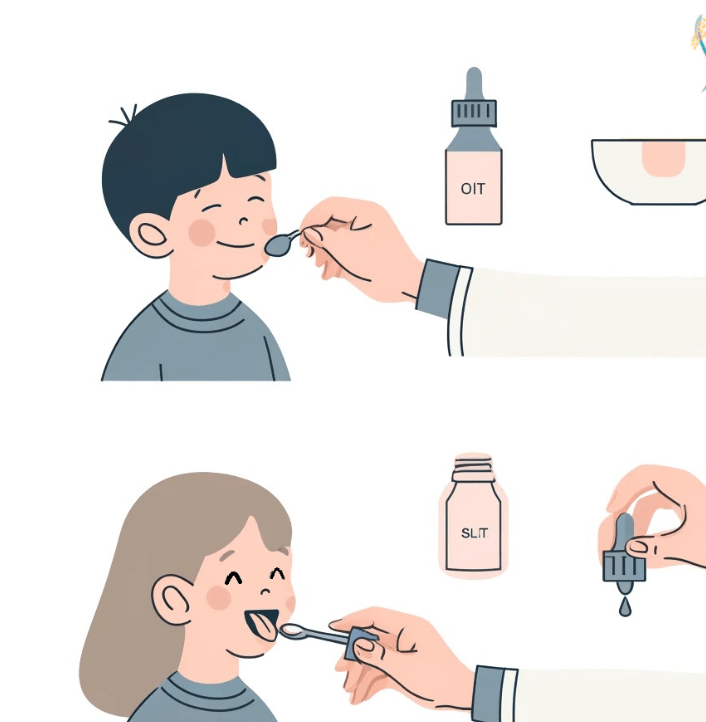

Over the past 10 years, very significant advances have been made in the field of food allergies and immunotherapy. Mainly with efforts focusing on allergen exposure orally. Oral immunotherapy (OIT) and Sublingual immunotherapy (SLIT) are the two treatments that have been most intensely studied and approved recently.
Immunotherapy is done through ingesting, at first, very small amounts of allergenic proteins over a period of time, then gradually increasing in a doctor’s setting, to develop desensitization and eventual tolerance to the protein and allergen. Many studies have looked at the use of OIT in milk, peanut, and egg allergies. Immunotherapy teaches the body to not react to problematic allergens.
OIT
OIT works by carefully introducing increasing doses of a food allergen to a patient under medical supervision. Peanut, egg, and milk OIT have been shown to desensitize approximately 60 to 80% of patients studied. There are still many unknowns about OIT. The only truly accurate way to predict if someone will have a reaction to the allergen is through ingestion. OIT or SLIT should never be attempted without clinical supervision. The ultimate goal of OIT is to be able to offer the patient protection from anaphylaxis by allowing them to ingest a full serving of the allergen without any reaction. However, this newfound desensitization can be lost if the allergen is not consumed on a consistent basis. OIT is also more restrictive compared to SLIT with no exercise allowed at least 1 hour after the allergen protein was ingested.
SLIT
SLIT uses a different but somewhat similar approach. Instead of swallowing the allergen, patients place it under the tongue, hold for a minute, then swallow. This method uses much smaller doses than OIT but still allows for the immune system to build tolerance. SLIT is considered safer and more convenient, with fewer severe reactions reported during treatment. SLIT also allows for complete flexibility when it comes to exercise, and not many restrictions.
While SLIT may not desensitize one’s allergies completely or as quick as OIT, many patients still experience great strides in their allergy-free journeys with these two options. For some, it could act as a security blanket and be peace of mind when it comes to accidental trace exposures. And, for others, it might be a stepping stone to potentially engaging in OIT in the future. The great news is the future is bright, especially when it comes to innovation within allergy advancements!!

 Behind The Label
Leave a reply to satyam rastogi Cancel reply